Choosing a B.Tech branch can feel confusing. Computer Science & Engineering (CSE), Artificial Intelligence & Machine Learning (AI/ML), Data Science, and Information Technology (IT) all offer strong career opportunities, but they are not exactly the same.
The good news is that there is no single “best” branch for every student. Your choice should depend on your interest, mathematical ability, coding skills, career goal, and the type of work you want to do.
India's technology job market is changing rapidly. The World Economic Forum identifies Big Data Specialists, AI and Machine Learning Specialists, and Software/Application Developers among the technology-related roles expected to grow strongly, while AI, big data, cybersecurity and technological literacy are becoming increasingly important skills.
| Factor | B.Tech CSE | B.Tech AI/ML | B.Tech Data Science | B.Tech IT |
|---|---|---|---|---|
| Main Focus | Computer & software technology | AI and machine learning | Data, statistics & insights | IT systems & applications |
| Coding | ????? | ????? | ???? | ???? |
| Mathematics | ??? | ????? | ????? | ??? |
| AI Exposure | High | Very High | High | Medium |
| Career Flexibility | Very High | High | High | High |
| Suitable For | Broad tech careers | AI/ML enthusiasts | Data & analytics enthusiasts | IT/software careers |
| Difficulty | Moderate–High | High | High | Moderate |
| Future Scope | Excellent | Excellent | Excellent | Very Good |
Computer Science & Engineering (CSE) is the broadest of the four options.
You learn programming, data structures, algorithms, databases, operating systems, computer networks, software engineering and other core technologies.
A CSE graduate can move into:
The biggest advantage of CSE is flexibility. You can start with software development and later move into AI, cloud, cybersecurity, data engineering or other technology areas.
Choose CSE if you:
Simple verdict: If you want the safest all-round technology option, CSE is difficult to beat.
AI/ML is more specialized than traditional CSE.
You study areas such as:
The demand for AI and machine-learning skills is expected to remain strong. The World Economic Forum lists AI and Machine Learning Specialists among India's fastest-growing technology-related job roles through 2030.
You can work as:
AI/ML can be a great choice if you:
Important: Don't choose AI/ML simply because you hear that “AI salaries are high.” The subject can involve considerably more mathematics and specialized learning than many students expect.
Data Science focuses on turning large amounts of data into useful information.
Think of it this way:
Data ? Analysis ? Pattern ? Insight ? Decision
You may study:
After Data Science, you can target roles such as:
Data Science can be particularly attractive if you enjoy numbers, statistics, problem-solving and finding patterns in information.
Choose it if you:
Simple verdict: Data Science is a strong option, but students should understand that it is not simply “CSE with a little AI.” Statistics and analytical thinking are important parts of the field.
Information Technology focuses heavily on the practical use and management of computing systems.
Typical subjects can include:
IT graduates can work as:
IT and CSE have significant overlap, and employers often care more about actual skills, projects and experience than simply the exact branch name on the degree.
Salary should not be the only reason to select a branch.
There is a huge difference between salaries offered by service companies, startups, product companies, GCCs and top technology companies.
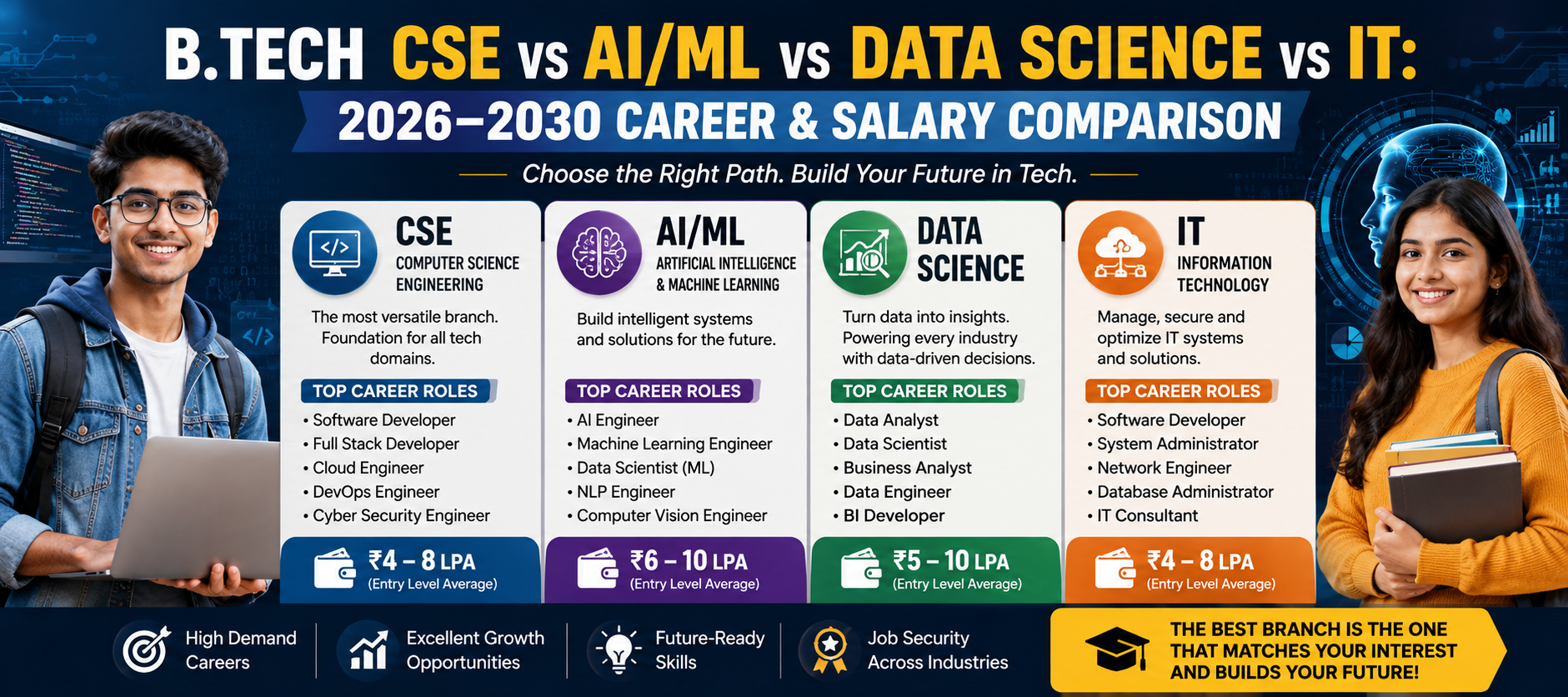
For example, current 2026 sources show broad entry-level ranges such as approximately ?4–8 LPA for software engineering, ?6–10 LPA for ML roles, and ?5–8 LPA for Data Science, but actual offers vary significantly by company, location and candidate skills.
A useful way to think about the market is:
| Branch | Typical Entry-Level Potential | Long-Term Potential |
|---|---|---|
| CSE | 4–8+ LPA | Very High |
| AI/ML | 6–10+ LPA | Very High |
| Data Science | 5–10+ LPA | Very High |
| IT | 4–8+ LPA | High |
These are indicative market ranges, not guaranteed salaries.
For example, current salary research shows that specialized AI/ML roles can command strong compensation, but the range is extremely wide depending on specialization and employer.
Instead of asking:
“Which branch will give me the highest salary?”
Ask:
“Which branch will help me build valuable skills for the next 5–10 years?”
The technology industry is moving toward:
The WEF estimates that 39% of workers' existing skill sets could be transformed or become outdated between 2025 and 2030, making continuous learning increasingly important.
This means your degree is only the beginning.
Regardless of your branch, try to build these skills:
C++/Java/Python + DSA + Web Development + SQL + Git + Cloud
Python + Mathematics + Statistics + ML + Deep Learning + GenAI + MLOps
Python + SQL + Statistics + Excel + Power BI/Tableau + Machine Learning
Programming + Database + Networking + Cloud + Cybersecurity + DevOps
And don't ignore communication skills.
The future technology professional will need a combination of technical skills + analytical thinking + creativity + communication + continuous learning. The WEF specifically highlights AI/big data, technological literacy, creative thinking and analytical thinking among increasingly important skills.
You want maximum flexibility and are not yet certain about your specialization.
You are genuinely interested in AI, mathematics, programming and intelligent systems.
You enjoy statistics, data analysis, numbers and solving business problems.
You want a practical technology career involving software, cloud, networking and IT systems.
Don't assume:
AI/ML degree = high salary
or
CSE degree = guaranteed software job.
Neither is true.
A student with CSE who develops strong AI skills can compete for AI/ML jobs. Similarly, a Data Science student with excellent programming and machine-learning skills can compete for many technology roles.
Your college + branch + skills + internships + projects + communication + interview preparation collectively influence your career.
If you are confused between these four branches in 2026, use this simple rule:
Want maximum flexibility? ? CSE
Passionate about Artificial Intelligence? ? AI/ML
Love data, statistics and analytics? ? Data Science
Interested in software and practical IT systems? ? IT
There is no single best branch for every student. The best branch is the one you can study seriously and build strong skills in.
For the 2026–2030 career market, AI, big data, software development, cloud and cybersecurity are all important areas. The smartest strategy is not to chase a branch name—it is to choose a solid foundation and continuously add industry-relevant skills.
How To Choose A College Based On Rank, Budget & Career Goal
11 October, 2026 By: AdmissionAdvisor Editorial TeamCollege Placement: 15 Things Students Must Check Before Admission
5 October, 2026 By: AdmissionAdvisor Editorial TeamSkills Vs Degree: What Will Matter More In The Future Job Market?
3 October, 2026 By: AdmissionAdvisor Editorial TeamHow To Verify UGC Recognition And University Affiliation Before Admission
22 September, 2026 By: AdmissionAdvisor Editorial TeamCloud Computing Career After B.Tech: Skills, Jobs & Scope In 2026–27
19 September, 2026 By: AdmissionAdvisor Editorial TeamWhich Course Is Better After 12th Commerce? A Complete Career Guide For Students
19 September, 2026 By: AdmissionAdvisor Editorial TeamFirst-Year College Guide 2026: 16 Things Every New Student Should Know Before Starting College
17 September, 2026 By: AdmissionAdvisor Editorial TeamBCA Vs B.Tech CSE: Which Is Better For A Software Career?
15 September, 2026 By: AdmissionAdvisor Editorial TeamNo Internship = No Job? How Important Are Internships Really?
13 September, 2026 By: AdmissionAdvisor Editorial TeamTop 20 Engineering Colleges In India : Ranking, Courses, Admission & How To Choose The Best College
11 September, 2026 By: AdmissionAdvisor Editorial TeamIs College Ranking More Important Than Placement?
9 September, 2026 By: AdmissionAdvisor Editorial TeamCollege Ranking Vs Placement Vs ROI: Which One Should Students Trust?
7 September, 2026 By: AdmissionAdvisor Editorial TeamWhat Should I Check Before Taking MBA Admission
7 September, 2026 By: AdmissionAdvisor Editorial TeamCan BCA Students Get Software Jobs? A Complete Career Guide
6 September, 2026 By: AdmissionAdvisor Editorial TeamHow To Verify Whether A College Is Genuine Before Admission In India
6 September, 2026 By: AdmissionAdvisor Editorial Team