Choosing a college is one of the biggest decisions a student makes after Class 12. With hundreds of colleges, courses, rankings, advertisements and placement claims available online, it can be difficult to understand which option is genuinely right for you.
The best college is not necessarily the most expensive, most popular or highest-ranked college. The right college is the one that matches your career goals, academic interests, budget, learning preferences and future plans.
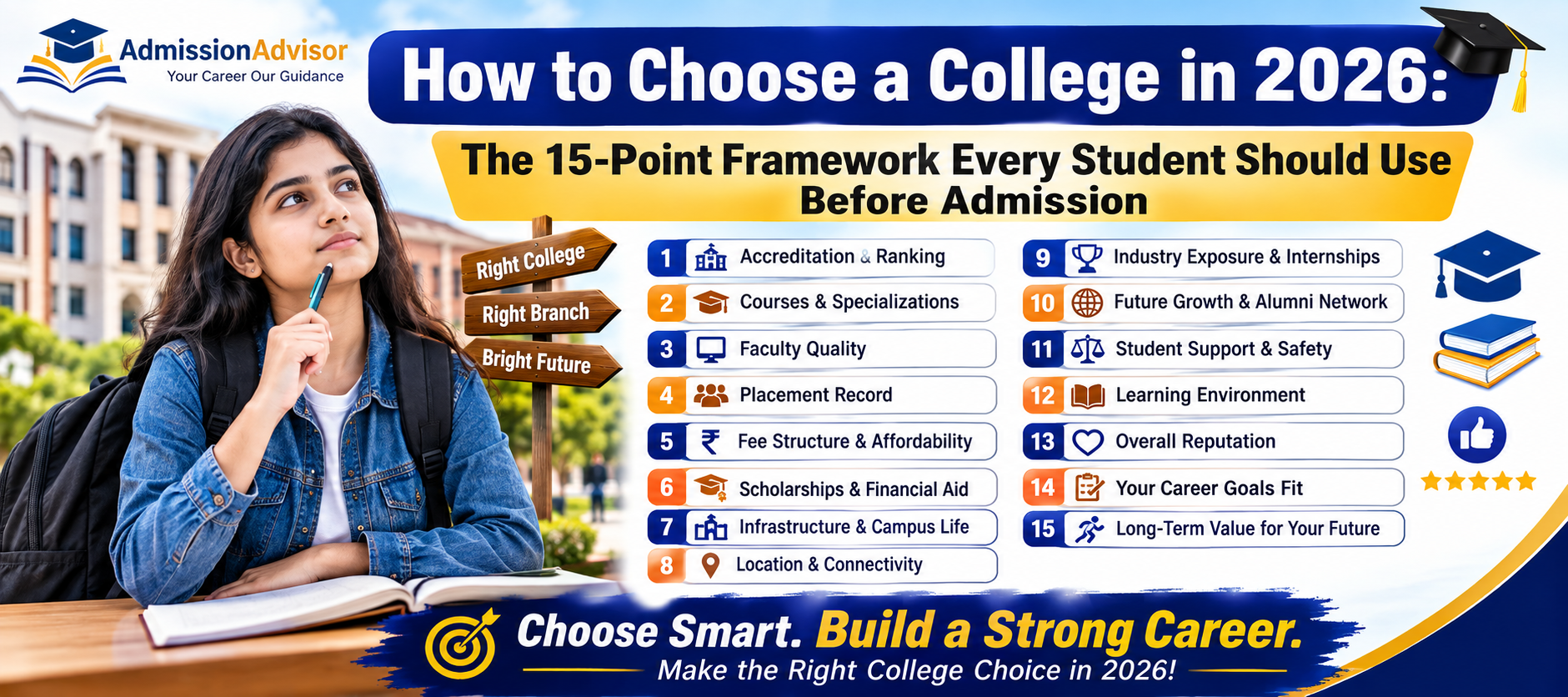
If you are planning college admission in 2026, use this 15-point college selection framework before making your final decision.
Before searching for a college, understand where you want your education to take you.
Do you want to become a software developer, engineer, manager, lawyer, designer, researcher, entrepreneur or professional in another field?
Your career goal should influence your choice of course and college.
For example, a student interested in software development may compare Computer Science, Information Technology, Artificial Intelligence or Data Science programs. A student interested in business may explore BBA, B.Com or integrated management programs.
You don't need to have your entire career planned at 17 or 18. However, having a general direction can make college selection much easier.
Many students make the mistake of choosing a famous college first and thinking about the course later.
Instead, start with:
Career goal ? Course ? Specialization ? College
The course curriculum, specialization and skills you develop can have a significant impact on your future opportunities.
Research the subjects, practical components, internships, projects and career pathways associated with each course before applying.
Never select a college based only on advertisements or social media.
Check the institution's official recognition, accreditation, approvals and affiliation status applicable to the program you want to study.
Depending on the course, students may need to verify information associated with bodies such as UGC, AICTE, NAAC, NIRF or professional regulatory organizations.
Always use official sources and current information because recognition and accreditation details can change.
Rankings can be useful, but they should not be your only deciding factor.
A college ranking may not tell you everything about:
Instead of asking only “Which college is ranked higher?”, ask:
“Which college is better for my course and career goals?”
That question will give you a much more useful comparison.
Tuition fees are only one part of the total cost.
Before admission, calculate:
A college that appears affordable initially may become expensive after adding accommodation and other costs.
Create a realistic four-year budget for undergraduate education whenever possible.
Don't automatically reject a college because of its published fee.
Check whether the institution offers scholarships based on:
Also compare scholarship conditions carefully. Understand whether the scholarship is available for the entire course or requires students to maintain specific academic performance.
Placement is one of the most important factors for many students, but placement advertisements can sometimes be difficult to interpret.
Don't look only at the highest package.
Try to understand:
A very high highest package may represent only one student and may not reflect the typical outcome.
Good infrastructure is valuable, but people are at the heart of education.
Look at the faculty profile for your intended department.
Consider:
Students should also try to understand how accessible faculty members are for academic guidance and projects.
A modern curriculum should help students develop knowledge as well as practical skills.
Look for:
For technology-related courses, students should pay particular attention to whether the curriculum is updated regularly.
Don't judge a campus only by photographs.
If possible, visit the campus before admission.
Check facilities such as:
The importance of each facility will depend on your course.
For engineering students, laboratories and workshops may be particularly important. For design students, studios and specialized equipment may matter more.
College location affects both student life and expenses.
Ask yourself:
A college that is slightly farther away may still be a better option if it offers stronger academic opportunities, but transportation and living costs should be considered.
College is not only about classrooms.
A healthy campus environment can help students develop communication, teamwork, leadership and social skills.
Explore opportunities such as:
However, remember that campus life should support your education—not replace it.
Student reviews can provide useful insights into campus life, faculty interaction, hostel facilities and overall experience.
But don't trust one review blindly.
Look for patterns across multiple genuine reviews.
Pay attention to both positive and negative feedback. Also remember that every student's experience can be different.
Avoid making an admission decision based solely on anonymous comments or promotional testimonials.
Once you have shortlisted colleges, create a comparison table.
For each college, compare:
| Factor | College A | College B | College C |
|---|---|---|---|
| Course | |||
| Total Fees | |||
| Scholarship | |||
| Accreditation | |||
| Placement | |||
| Faculty | |||
| Infrastructure | |||
| Hostel | |||
| Location | |||
| Career Support |
This simple exercise can make your decision much clearer.
Don't compare 20 colleges endlessly. A shortlist of around three to five suitable options can be easier to evaluate.
The final question is:
“Where will this college take me after graduation?”
Don't choose a college simply because admission is easy.
Think about the skills you will develop, the professional network you can build, internship opportunities, career services, higher education opportunities and the overall learning environment.
Your college is an investment of several years of your life.
Choose carefully.
A simple way to remember the framework is:
Career Goal + Right Course + Quality Education + Affordability + Career Opportunities = Smart College Choice
There is no single college that is perfect for every student.
A college that is ideal for your friend may not be ideal for you.
Your decision should be based on your interests, academic profile, family budget and career ambitions.
Before finalizing admission, avoid these common mistakes:
A ranking number does not tell the complete story.
Your friend's career goals may be completely different from yours.
Always investigate average, median and course-specific placement information where available.
Hostel, transportation, food and other expenses can significantly increase the total cost.
Always verify current recognition and approval information from reliable official sources.
Research colleges early so you have enough time to compare your options.
Choosing a college in 2026 doesn't have to be overwhelming.
You don't need to find the “perfect college.” You need to find the college that is the right fit for you.
Take time to understand your career interests. Compare courses. Research colleges. Check recognition. Calculate the complete cost. Investigate placement information. Talk to your parents. Visit campuses where possible. Ask questions before paying admission fees.
Most importantly, don't let advertisements, rankings or peer pressure make the decision for you.
Your college journey is about more than getting admission. It is about building the knowledge, skills, confidence and experience that will shape your future.
If you're confused about courses, colleges, fees, placements, admission procedures or career options, the Admission Advisor Student Forum can help you explore the questions that matter before making your decision.
How To Choose A College Based On Rank, Budget & Career Goal
11 October, 2026 By: AdmissionAdvisor Editorial TeamCollege Placement: 15 Things Students Must Check Before Admission
5 October, 2026 By: AdmissionAdvisor Editorial TeamSkills Vs Degree: What Will Matter More In The Future Job Market?
3 October, 2026 By: AdmissionAdvisor Editorial TeamHow To Verify UGC Recognition And University Affiliation Before Admission
22 September, 2026 By: AdmissionAdvisor Editorial TeamCloud Computing Career After B.Tech: Skills, Jobs & Scope In 2026–27
19 September, 2026 By: AdmissionAdvisor Editorial TeamWhich Course Is Better After 12th Commerce? A Complete Career Guide For Students
19 September, 2026 By: AdmissionAdvisor Editorial TeamFirst-Year College Guide 2026: 16 Things Every New Student Should Know Before Starting College
17 September, 2026 By: AdmissionAdvisor Editorial TeamBCA Vs B.Tech CSE: Which Is Better For A Software Career?
15 September, 2026 By: AdmissionAdvisor Editorial TeamNo Internship = No Job? How Important Are Internships Really?
13 September, 2026 By: AdmissionAdvisor Editorial TeamTop 20 Engineering Colleges In India : Ranking, Courses, Admission & How To Choose The Best College
11 September, 2026 By: AdmissionAdvisor Editorial TeamIs College Ranking More Important Than Placement?
9 September, 2026 By: AdmissionAdvisor Editorial TeamCollege Ranking Vs Placement Vs ROI: Which One Should Students Trust?
7 September, 2026 By: AdmissionAdvisor Editorial TeamWhat Should I Check Before Taking MBA Admission
7 September, 2026 By: AdmissionAdvisor Editorial TeamCan BCA Students Get Software Jobs? A Complete Career Guide
6 September, 2026 By: AdmissionAdvisor Editorial TeamHow To Verify Whether A College Is Genuine Before Admission In India
6 September, 2026 By: AdmissionAdvisor Editorial Team