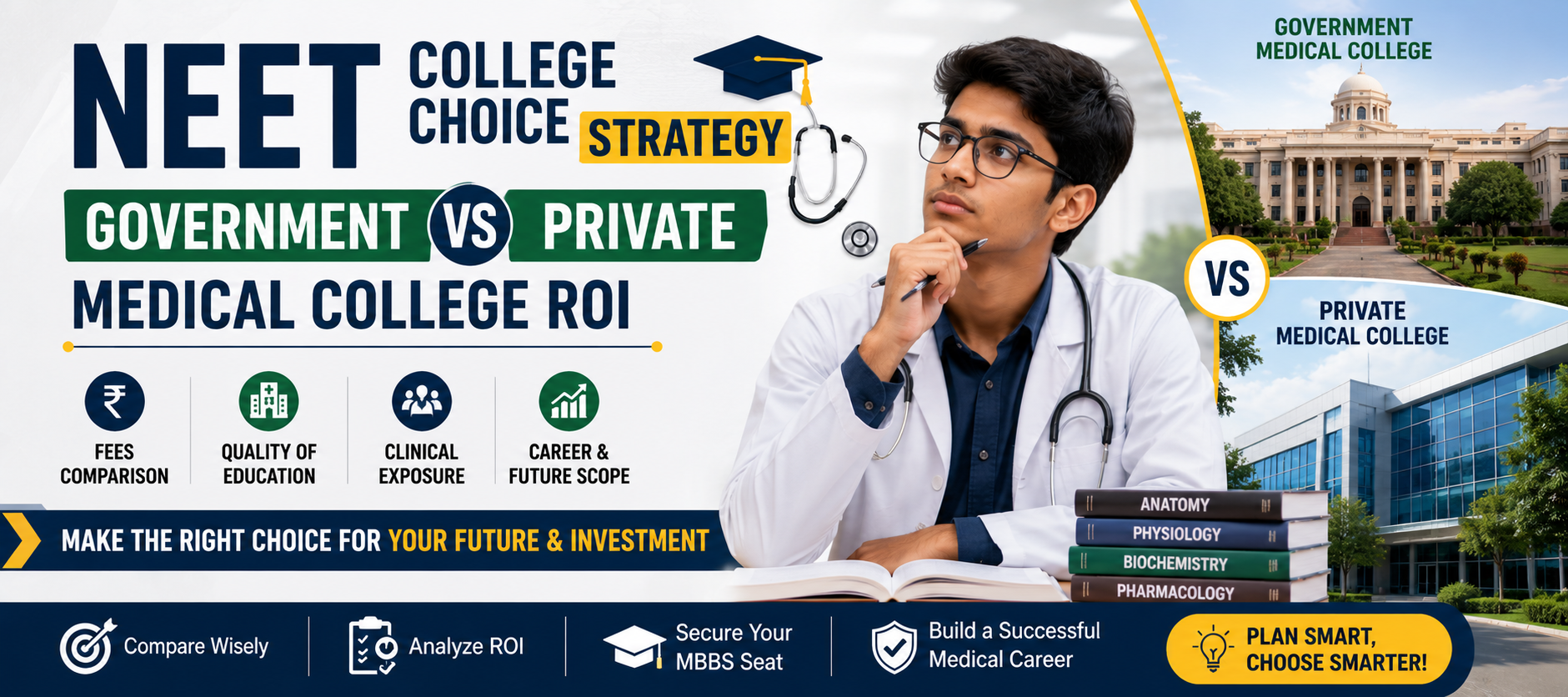
Choosing a medical college after NEET is one of the biggest decisions for an aspiring doctor. Many students immediately look at NEET cutoff, college ranking, or fees, but a better approach is to compare the complete picture: education quality, total cost, clinical exposure, internship, infrastructure, location, and long-term career value.
The most common question is:
Government medical college or private medical college — which offers better ROI?
The answer depends on your NEET score, budget, career goals, and the specific college you are considering.
ROI means Return on Investment.
In simple words:
How much value do you get from the money and time invested in your medical education?
For MBBS, ROI should not be judged only by salary. You should also consider:
A college with lower fees can have excellent ROI, but a good private medical college can also provide strong value when government seats are difficult to obtain.
| Factor | Government Medical College | Private Medical College |
|---|---|---|
| Tuition Fees | Usually much lower | Usually higher |
| NEET Competition | Very high | Varies by college/seat |
| Patient Exposure | Often strong | Depends on hospital & patient flow |
| Infrastructure | Varies | Often modern, but varies |
| Hostel & Facilities | Varies | Often better facilities in some colleges |
| Financial Investment | Lower | Higher |
| ROI | Generally excellent when fees are low | Depends strongly on fees and college quality |
| Competition | High | Varies |
| PG Preparation | Strong environment in many colleges | Depends on academic environment |
| Location Choices | Limited by rank/counselling | Usually more options |
Important: Not every government college is automatically better than every private college. The individual college and its attached hospital matter greatly.
The biggest advantage of a government medical college is generally lower tuition fees.
Students can receive an MBBS education at a much lower direct academic cost than many private institutions.
This can significantly reduce the financial burden on students and families.
Lower fees:
The biggest attraction for most students.
Strong clinical exposure:
Many government hospitals handle a large number of patients, giving students opportunities to observe a wide range of medical conditions.
Competitive environment:
Students often study alongside high-performing NEET candidates.
Lower financial pressure:
Because the overall education cost can be lower, students may have greater financial flexibility for PG preparation and future education.
Government colleges can also have challenges:
Therefore, students should evaluate the specific college, not simply the word “government.”
Private medical colleges can require a substantially higher financial investment.
However, this does not automatically mean they provide poor ROI.
Some private medical colleges offer:
But the most important question is:
Does the college provide sufficient academic and clinical value for the total amount you will spend?
This is where careful comparison becomes extremely important.
Students often compare only tuition fees.
That is a mistake.
Calculate the complete cost of MBBS.
Total Cost = Tuition Fees + Hostel + Food + Books + Examination Fees + Transportation + Other Charges
For private colleges, also carefully check whether the advertised fee excludes additional charges.
Before accepting admission, ask for the complete fee structure in writing.
MBBS is a practical profession.
You need more than classrooms and textbooks.
A college's attached hospital is therefore extremely important.
Check:
Good hospital + good patient exposure = better clinical learning opportunity.
A college with impressive buildings but limited patient exposure may not provide the same practical learning experience.
Ranking can be useful, but it should not be your only deciding factor.
Instead, look at:
College reputation + hospital quality + academics + clinical exposure + fees + student feedback
Also verify information from official sources rather than relying entirely on advertisements or social media posts.
If you secure a good government medical college through NEET counselling at a relatively low fee, the ROI can be excellent.
Why?
Because the initial financial investment is generally much lower while you can receive substantial academic and clinical exposure.
A private medical college can also have good ROI if:
However, if the total cost is extremely high, you should think carefully about the financial return and your family's ability to manage the expense.
NEET cutoff tells you about admission competitiveness.
It does not automatically tell you the complete quality of a medical college.
Before making your final decision, compare:
You don't need a complicated financial formula.
Use this simple comparison:
Medical College ROI Score = Education Quality + Clinical Exposure + Career Opportunities ? Total Cost
For example:
Potential ROI: Very High
Potential ROI: Needs Careful Evaluation
Potential ROI: Potentially Strong
This approach helps students look beyond the college's name.
Before paying an admission fee, ask the college:
Always verify important admission information from official counselling authorities and the college itself before making a financial commitment.
Medical education is a long-term investment.
A private MBBS seat may look attractive after you miss a government seat, but don't make an emotional decision.
Consider:
Can the family comfortably manage the complete course cost without creating excessive financial stress?
Also think about your future expenses, including:
The cheapest college is not always the best, and the most expensive college is not automatically the best.
A smart student can follow this process:
Understand which colleges and counselling categories are realistically available.
Create three groups:
Dream Colleges ? Target Colleges ? Safe Options
Don't reject a college simply because it is private. Compare its actual quality and total cost.
This is one of the most important steps for MBBS.
Don't look only at tuition fees.
Verify current regulatory and counselling information through official sources.
Student experiences can help you understand hostel life, academics and clinical exposure.
Think beyond admission.
Ask:
Where will I get the best combination of education, clinical training, affordability and career preparation?
For most students, a good government medical college with reasonable fees and strong clinical exposure offers excellent ROI.
But that does not mean every private medical college is a poor choice.
A good private medical college with strong academics, a busy teaching hospital, good infrastructure and financially manageable fees can also be a sensible option.
The right decision is not simply:
Government = Good
Private = Bad
Instead, think:
College Quality + Clinical Exposure + Total Cost + Career Opportunities = Real ROI
Your NEET score may determine which doors are open, but smart college comparison helps you choose the right door.
Choosing an MBBS college is a major decision for both students and parents. Don't make the choice only because of a college name, advertisement, ranking or pressure from others.
Compare the complete picture—fees, hospital exposure, academics, infrastructure, student experience, location and future opportunities.
If you carefully compare government and private medical colleges before counselling and admission, you can make a decision that is academically strong and financially sensible.
Remember: The best medical college is not necessarily the cheapest or the most expensive. It is the college that provides the right combination of quality education, clinical exposure and long-term value for your career.
How To Choose A College Based On Rank, Budget & Career Goal
11 October, 2026 By: AdmissionAdvisor Editorial TeamCollege Placement: 15 Things Students Must Check Before Admission
5 October, 2026 By: AdmissionAdvisor Editorial TeamSkills Vs Degree: What Will Matter More In The Future Job Market?
3 October, 2026 By: AdmissionAdvisor Editorial TeamHow To Verify UGC Recognition And University Affiliation Before Admission
22 September, 2026 By: AdmissionAdvisor Editorial TeamCloud Computing Career After B.Tech: Skills, Jobs & Scope In 2026–27
19 September, 2026 By: AdmissionAdvisor Editorial TeamWhich Course Is Better After 12th Commerce? A Complete Career Guide For Students
19 September, 2026 By: AdmissionAdvisor Editorial TeamFirst-Year College Guide 2026: 16 Things Every New Student Should Know Before Starting College
17 September, 2026 By: AdmissionAdvisor Editorial TeamBCA Vs B.Tech CSE: Which Is Better For A Software Career?
15 September, 2026 By: AdmissionAdvisor Editorial TeamNo Internship = No Job? How Important Are Internships Really?
13 September, 2026 By: AdmissionAdvisor Editorial TeamTop 20 Engineering Colleges In India : Ranking, Courses, Admission & How To Choose The Best College
11 September, 2026 By: AdmissionAdvisor Editorial TeamIs College Ranking More Important Than Placement?
9 September, 2026 By: AdmissionAdvisor Editorial TeamCollege Ranking Vs Placement Vs ROI: Which One Should Students Trust?
7 September, 2026 By: AdmissionAdvisor Editorial TeamWhat Should I Check Before Taking MBA Admission
7 September, 2026 By: AdmissionAdvisor Editorial TeamCan BCA Students Get Software Jobs? A Complete Career Guide
6 September, 2026 By: AdmissionAdvisor Editorial TeamHow To Verify Whether A College Is Genuine Before Admission In India
6 September, 2026 By: AdmissionAdvisor Editorial Team