


Why Are Many Graduates Still Unemployed Despite Having A College Degree?
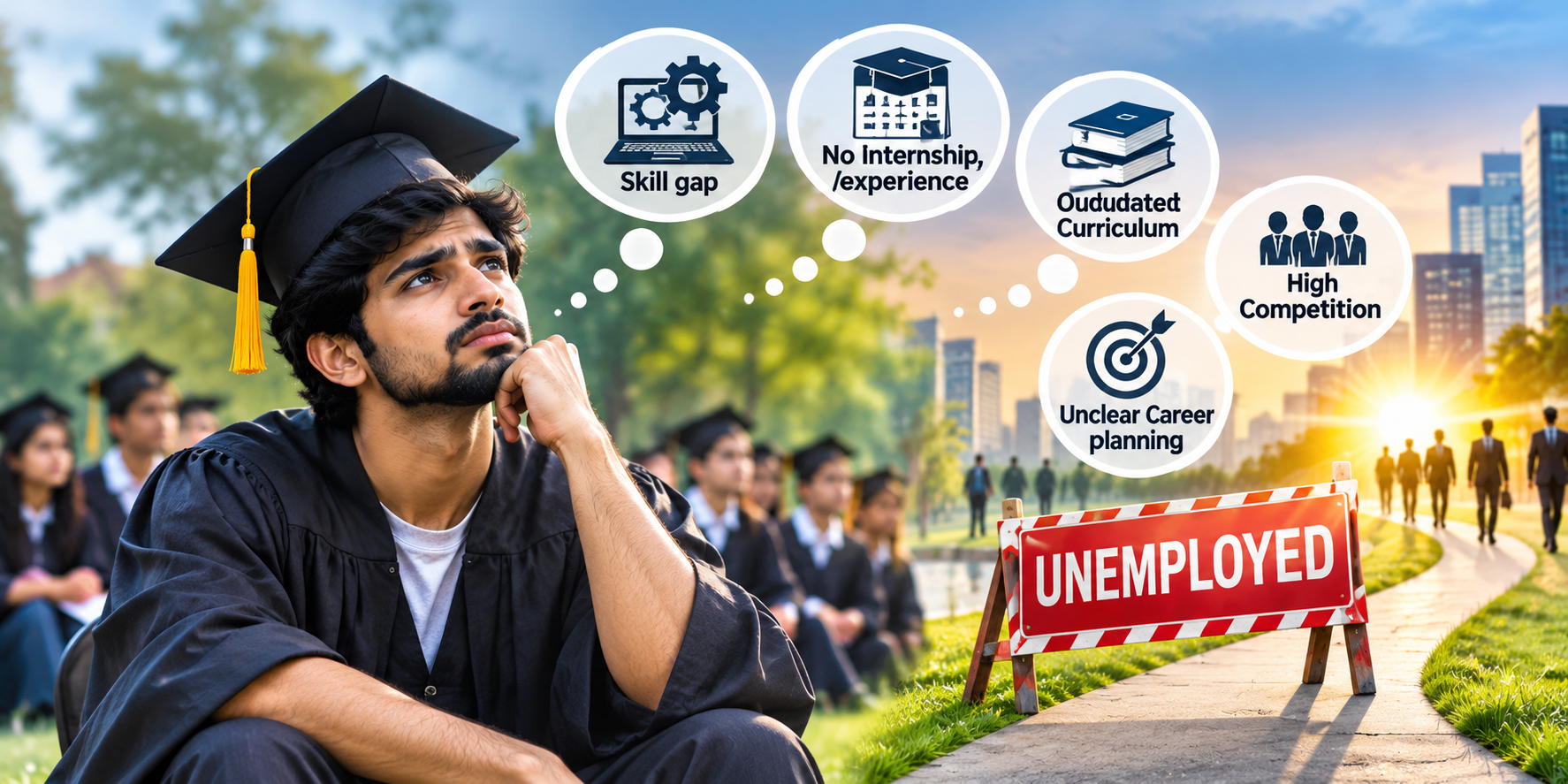
Every year, millions of students in India complete graduation in courses such as B.Tech, BBA, BCA, MBA, B.Com, B.Sc and BA. They spend several years studying, preparing for examinations and earning academic qualifications with the hope of building a successful career.
However, after completing their degrees, many graduates struggle to find suitable jobs. Some remain unemployed for months, while others accept positions that do not match their qualifications, interests or salary expectations.
This raises an important question: **Why are so many graduates still unemployed despite having a college degree?**
The problem is not simply a lack of jobs. There is also a gap between academic education, practical skills, industry requirements and students' career preparation.
Let's understand the major reasons and what students can do to improve their employment opportunities in 2027.
## 1. Lack of Practical Knowledge and Industry Skills
One of the biggest challenges is the difference between theoretical knowledge and practical workplace requirements.
Many students understand concepts from textbooks but have limited experience applying them to real projects.
For example:
- A B.Tech student may know programming concepts but struggle to develop a working application.
- A BBA graduate may understand business management but lack practical marketing experience.
- A B.Com student may know accounting theory but have limited experience with accounting software.
- A BCA graduate may understand databases but have never worked on a real-world software project.
Companies generally look for candidates who can apply their knowledge to actual business problems.
**Solution:** Students should work on practical projects, attend workshops, complete internships and learn tools relevant to their chosen careers.
## 2. Outdated College Curriculum
Technology and business requirements are changing rapidly. However, some educational institutions take time to update their courses and teaching methods.
Students may graduate without sufficient exposure to technologies, software, tools and professional practices currently used by employers.
For example, computer science students should understand programming fundamentals while also exploring cloud computing, artificial intelligence, cybersecurity and modern software development practices.
Similarly, management students should gain exposure to digital marketing, business analytics, communication and project management.
**Solution:** Colleges should regularly update their curriculum, involve industry professionals and provide opportunities for practical learning.
Students should also take responsibility for learning beyond their classroom syllabus.
## 3. Lack of Internship and Work Experience
Many companies prefer candidates who have some understanding of professional working environments.
Unfortunately, a large number of students complete graduation without completing even one meaningful internship.
As a result, they may struggle with workplace communication, teamwork, deadlines and professional responsibilities.
Internships help students understand:
- How companies operate.
- How teams work together.
- How professional projects are managed.
- How to communicate with clients and colleagues.
- How theoretical knowledge is applied in real situations.
**Solution:** Students should try to complete at least one or two relevant internships before graduation. Live projects, apprenticeships and industry assignments can also provide valuable experience.
## 4. Poor Communication and Interview Skills
Technical knowledge alone may not be enough to secure a job.
Many candidates struggle to explain their ideas, introduce themselves confidently or answer interview questions clearly.
Employers may assess:
- Verbal and written communication.
- Confidence and professional behavior.
- Problem-solving ability.
- Teamwork and adaptability.
- Ability to explain previous projects.
Students who have good technical knowledge but cannot communicate it effectively may lose valuable opportunities.
**Solution:** Practice English and professional communication, participate in group discussions, prepare for interviews and conduct mock interviews with friends or mentors.
## 5. Increasing Competition for Jobs
The number of graduates entering the employment market continues to grow. However, suitable graduate-level opportunities are not increasing at the same pace in every sector or location.
Students from different colleges and universities often compete for the same entry-level positions.
A degree alone may not be enough to differentiate one candidate from hundreds of other applicants.
According to Azim Premji University's *State of Working India 2026*, the transition from education to employment remains a major challenge, partly because graduate numbers have increased faster than graduate employment opportunities.
**Solution:** Students should develop specialized skills, build strong portfolios, explore multiple industries and apply for suitable opportunities consistently.
## 6. Choosing a Course Without Proper Career Planning
Some students select a course because of family expectations, peer pressure, college popularity or admission availability.
They may not understand the career opportunities associated with their chosen degree.
For example, a student pursuing BBA may not know whether to prepare for an MBA, marketing, finance, human resources or entrepreneurship.
Similarly, a student pursuing B.Tech may not have a clear direction regarding software development, data science, cybersecurity or core engineering.
Without proper planning, students may complete their degrees without developing a clear professional direction.
**Solution:** Students should research career options, understand industry requirements and identify the skills needed for their preferred jobs before choosing a course.
## 7. Lack of Digital and Technology Skills
Digital skills are becoming important across almost every industry.
Even non-technical graduates may need to use spreadsheets, presentation software, online collaboration platforms, business applications and AI tools.
Students who do not understand commonly used workplace technologies may face difficulties during recruitment.
Some useful skills include:
| Career area | Skills to develop |
|---|---|
| Engineering | Programming, cloud computing, AI and software development |
| Management | Excel, communication, marketing and business analytics |
| Commerce | Accounting software, taxation, Excel and financial analysis |
| Computer Applications | Python, Java, databases and web development |
| Arts and Humanities | Research, writing, digital communication and content development |
**Solution:** Students should identify the tools used in their chosen industry and develop practical experience with them.
## 8. High Salary Expectations and Limited Job Opportunities
Some fresh graduates expect high salaries immediately after completing their degrees.
However, entry-level salaries depend on several factors, including skills, location, company size, job responsibilities and industry demand.
When students reject every opportunity because the initial salary is below their expectations, they may miss valuable opportunities to gain experience.
This does not mean students should accept unfair salaries or poor working conditions.
**Solution:** Evaluate opportunities based on learning potential, career growth, work environment, salary and future prospects. Your first job should help you develop professional experience and stronger career options.
## 9. How Artificial Intelligence Is Changing the Job Market
Artificial intelligence is changing how companies work and what they expect from employees.
Some repetitive tasks can now be automated, while new opportunities are developing in areas such as AI development, data analytics, cybersecurity, automation and AI-supported business operations.
Students who depend only on basic knowledge may find it difficult to compete in changing job markets.
However, AI also creates opportunities for people who can use technology effectively and combine it with human skills.
**Solution:** Learn how to use AI tools responsibly, understand their limitations and develop complementary skills such as critical thinking, creativity, communication and problem-solving.
Students should focus on learning with AI rather than depending entirely on AI-generated work.
## 10. What Should Students Do to Become Job-Ready Before Graduation?
Students do not need to wait until graduation to start preparing for employment.
A practical career preparation plan can make a significant difference.
| Student activity | Recommended action |
|---|---|
| Technical skills | Learn tools related to your chosen career |
| Internship | Gain relevant work experience |
| Projects | Complete at least 2–3 meaningful projects |
| Communication | Practice speaking and professional writing |
| Resume | Prepare a clear, updated resume |
| LinkedIn | Build a professional profile |
| Interview | Practice common interview questions |
| Networking | Connect with professionals and alumni |
| Job applications | Apply consistently to relevant openings |
## 11. What Should Colleges Do to Improve Graduate Employability?
The responsibility does not belong only to students. Colleges and universities also have an important role in preparing graduates for employment.
Educational institutions should:
1. Update courses according to changing industry requirements.
2. Build stronger relationships with companies.
3. Provide internships and apprenticeship opportunities.
4. Organize regular placement preparation sessions.
5. Teach communication and professional skills.
6. Encourage practical projects and entrepreneurship.
7. Publish transparent placement information, including median salaries and the number of students placed.
A college should not focus only on admissions and examination results. It should also help students prepare for real career opportunities.
## 12. Conclusion: A College Degree Is the Beginning, Not the Guarantee of a Job
A college degree remains an important qualification, but it does not automatically guarantee employment.
The job market increasingly rewards candidates who combine academic knowledge with practical skills, professional experience, communication and continuous learning.
Students should start preparing for their careers during college instead of waiting until graduation.
Colleges should also focus on industry exposure, practical education and genuine placement support.
**Remember: Your degree may help you enter the job market, but your skills, experience and ability to learn will help you build a successful career.**
## Frequently Asked Questions (FAQs)
### 1. Why are graduates unemployed in India?
Graduates may struggle to find jobs because of limited suitable vacancies, skill gaps, lack of practical experience, communication challenges and competition for entry-level positions.
### 2. Is a college degree enough to get a job in 2027?
A degree is an important qualification, but employers may also look for practical skills, internships, projects, communication and problem-solving abilities.
### 3. Which skills should students learn before graduation?
Students should develop communication, digital literacy, problem-solving, teamwork and career-specific technical skills. Learning to use relevant AI tools can also be helpful.
### 4. Are internships important for fresh graduates?
Yes. Internships provide workplace exposure, practical knowledge, professional experience and opportunities to build industry connections.
### 5. How can an unemployed graduate improve their career prospects?
Graduates can improve their prospects by learning relevant skills, building a portfolio, completing projects, improving their resume, preparing for interviews and applying for suitable jobs.
### 6. Can students get jobs without experience?
Yes. Many companies recruit freshers for entry-level positions. However, projects, internships, certifications and practical skills can improve a candidate's chances.
### 7. Will AI reduce job opportunities for freshers?
AI may automate some tasks and change entry-level job requirements, while creating demand for new skills and roles. Students should learn to work effectively with AI.
---
**About AdmissionAdvisor.in**
AdmissionAdvisor.in helps students explore colleges, courses, admission opportunities, career options and educational guidance. Join our Student Forum to share experiences, ask questions and learn from other students.