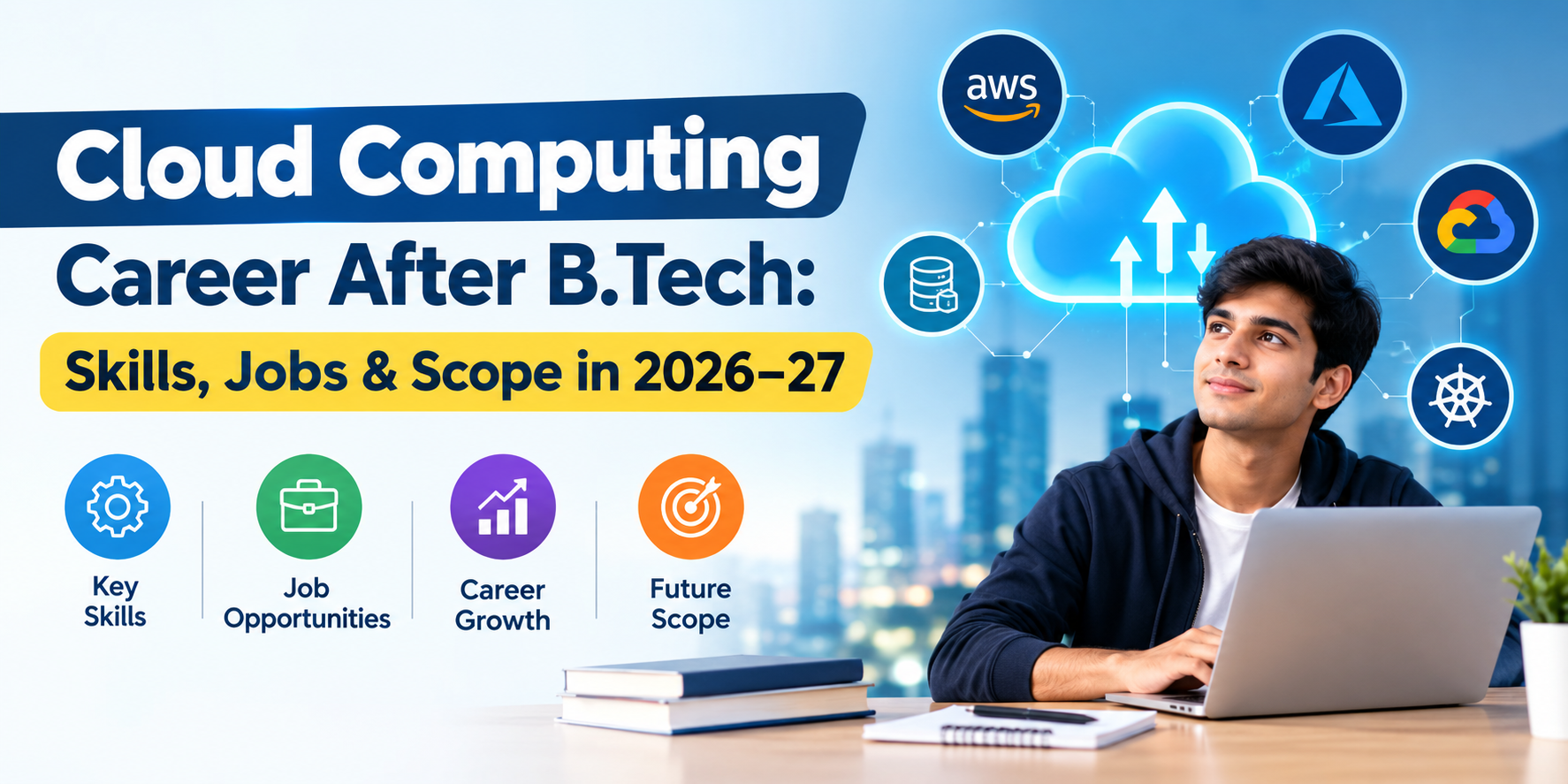
Cloud computing has become an important part of modern software development, data infrastructure, cybersecurity and digital services. For B.Tech students, this creates career opportunities across cloud engineering, DevOps, cloud development, infrastructure, networking, security and data engineering.
But choosing cloud computing as a career is not simply about learning AWS, Microsoft Azure or Google Cloud. Students need a combination of programming, Linux, networking, databases, cloud services, automation, security and practical project experience.
This guide explains the career options, skills, certifications and learning path a B.Tech student can consider after graduation.
A B.Tech graduate can enter cloud-related careers through roles such as:
Cloud is also increasingly connected with AI, data engineering and cybersecurity. Google Cloud's current certification framework, for example, includes roles such as Cloud Engineer, Cloud Developer, Cloud DevOps Engineer, Cloud Security Engineer, Cloud Network Engineer, Data Engineer and Cloud Architect.
Companies increasingly use cloud infrastructure to develop, deploy, store and operate digital applications and data.
India's broader digital infrastructure is also expanding. According to an April 2026 IBEF report citing Vestian, India's data-centre market was valued at about US$10 billion in 2025 and was projected to reach approximately US$22 billion by 2030, with cloud computing and AI identified among the growth drivers.
This does not mean every B.Tech graduate will automatically get a cloud job. The important point for students is that cloud skills are being integrated into several technology career paths.
A Cloud Engineer works with cloud infrastructure and services, including deployment, configuration, monitoring and security.
Typical responsibilities can include:
Google's Associate Cloud Engineer role description includes deploying and securing applications and infrastructure, monitoring operations and maintaining enterprise cloud solutions.
DevOps combines software development and IT operations.
A DevOps Engineer may work on:
Students interested in this career should learn Git, Linux, Docker, Kubernetes, CI/CD and at least one major cloud platform.
Cloud Developers build applications that run on cloud platforms.
Important areas include:
Google's current Professional Cloud Developer framework includes cloud-native applications, containers, APIs, orchestration tools, managed services, serverless platforms and databases.
For B.Tech CSE/IT students who enjoy programming, this can be a natural cloud career direction.
As companies move applications and data to cloud environments, security becomes an important technical area.
Cloud security work can include:
Students interested in cybersecurity can therefore combine cloud + security rather than treating them as completely separate career paths.
Cloud applications depend heavily on networking.
A Cloud Network Engineer may work with:
Students should understand basic networking concepts such as TCP/IP, DNS, HTTP/HTTPS, subnets, routing and firewalls before moving into advanced cloud networking.
Cloud platforms are widely used for storing, processing and analyzing large datasets.
A Data Engineer may work with:
This makes cloud + data engineering another useful combination for B.Tech graduates.
Cloud Architect is generally an experienced role rather than a typical first job after B.Tech.
A Cloud Architect designs cloud solutions based on requirements such as:
Students should therefore think of Cloud Architect as a long-term career path, not necessarily an entry-level position.
Google classifies Cloud Architect as a professional-level certification role requiring more advanced experience than its foundational and associate-level paths.
A strong cloud profile should combine several technical areas.
Learn:
Linux is particularly useful for cloud infrastructure and DevOps roles.
Understand:
Without networking fundamentals, many cloud concepts become difficult to understand.
You do not necessarily need to become an expert programmer before starting cloud learning.
However, students should be comfortable with at least one programming or scripting language such as:
Python is particularly useful for automation and scripting.
Choose one major platform initially rather than trying to learn everything simultaneously.
Common options include:
Once your fundamentals are strong, learning a second platform becomes easier.
Understand basic concepts involving:
Learn:
Important tools and concepts include:
Certification can help structure learning, but it should not replace practical experience.
Google Cloud currently provides different credential levels, including foundational certificates, skill badges, associate certifications and professional certifications. Its Associate Cloud Engineer certification has no formal prerequisite, although Google recommends around six months of hands-on experience with Google Cloud before attempting the exam.
For beginners, the sensible approach is:
Learn fundamentals ? build projects ? practice on a cloud platform ? consider certification.
Do not collect multiple certificates without understanding the underlying technology.
Focus on:
Learn:
Start building small projects.
Learn:
Choose one direction:
Cloud Engineering
or
DevOps
or
Cloud Security
or
Cloud Development
or
Cloud Data Engineering
Then build a portfolio around that specialization.
A certificate is useful, but projects can demonstrate that you can actually apply what you learned.
Build a simple application and deploy it to a cloud platform.
Create an application using a managed cloud database.
Build a pipeline that automatically tests and deploys an application.
Containerize an application using Docker and deploy it to a cloud environment.
Deploy an application and configure monitoring, logging and alerts.
For each project, document:
Problem ? Architecture ? Technologies ? Implementation ? Result ? GitHub Repository
Cloud computing does not replace software development.
In many companies, cloud knowledge is an additional skill used by software developers, DevOps engineers, data engineers and security professionals.
For example:
Software Developer + Cloud
can lead toward cloud application development.
Networking + Cloud
can lead toward cloud infrastructure or network engineering.
Cybersecurity + Cloud
can lead toward cloud security.
Data Engineering + Cloud
can lead toward cloud data roles.
This is why B.Tech students should think about cloud as a skill ecosystem, rather than only a single job title.
Cloud computing can provide multiple technology career paths, but students should make the decision based on their interests and strengths.
Choose cloud if you enjoy:
It may be particularly useful to combine cloud with another strong technical area such as:
Cloud + DevOps
Cloud + Cybersecurity
Cloud + AI
Cloud + Data Engineering
Cloud + Software Development
A common mistake is starting directly with advanced Kubernetes, multi-cloud architecture or complex DevOps tools.
A better sequence is:
Programming
?
Linux
?
Networking
?
Git
?
Cloud Fundamentals
?
Cloud Services
?
Docker
?
CI/CD
?
Infrastructure as Code
?
Kubernetes
?
Cloud Security & Architecture
This creates a stronger foundation.
Yes. CSE students already study programming, operating systems, databases and networking, which can provide a useful foundation for cloud learning.
Yes. IT students can build cloud careers by developing cloud platform, Linux, networking, programming and automation skills.
Coding requirements vary by role. Cloud developers generally need stronger programming skills, while infrastructure-oriented roles may emphasize Linux, networking, automation and cloud administration. Scripting remains useful across many cloud roles.
No single certification is universally compulsory. Practical skills, projects, technical fundamentals and relevant experience also matter.
Yes. Cloud platforms offer learning paths for different experience levels. Google Cloud, for example, provides foundational cloud certificates without prior cloud experience, while its more advanced credentials are designed for deeper technical expertise.
There is no single platform that is universally best for every student or employer. AWS, Microsoft Azure and Google Cloud all provide extensive cloud services. Students should choose one platform to learn deeply first and then expand their knowledge.
Generally, students should treat Cloud Architect as a longer-term career destination. It requires broader knowledge of cloud infrastructure, security, networking, applications and business requirements.
A B.Tech degree can provide the foundation for a career in cloud computing, but the degree alone is not enough.
The strongest approach is to combine your engineering education with:
Programming + Linux + Networking + Cloud + DevOps + Security + Projects
Start with fundamentals, select one cloud platform, build practical projects and gradually specialize.
Cloud computing also overlaps with several growing technology areas, including cybersecurity, data engineering, software development and AI. India's expanding digital infrastructure provides a broader technology environment in which these skills can be applied.
For students choosing a college or B.Tech specialization, the important question is not simply "Does the college teach cloud computing?
Cloud Computing Career After B.Tech: Skills, Jobs & Scope In 2026–27
19 September, 2026 By: AdmissionAdvisor Editorial TeamWhich Course Is Better After 12th Commerce? A Complete Career Guide For Students
19 September, 2026 By: AdmissionAdvisor Editorial TeamFirst-Year College Guide 2026: 16 Things Every New Student Should Know Before Starting College
17 September, 2026 By: AdmissionAdvisor Editorial TeamBCA Vs B.Tech CSE: Which Is Better For A Software Career?
15 September, 2026 By: AdmissionAdvisor Editorial TeamNo Internship = No Job? How Important Are Internships Really?
13 September, 2026 By: AdmissionAdvisor Editorial TeamTop 20 Engineering Colleges In India : Ranking, Courses, Admission & How To Choose The Best College
11 September, 2026 By: AdmissionAdvisor Editorial TeamIs College Ranking More Important Than Placement?
9 September, 2026 By: AdmissionAdvisor Editorial TeamCollege Ranking Vs Placement Vs ROI: Which One Should Students Trust?
7 September, 2026 By: AdmissionAdvisor Editorial TeamWhat Should I Check Before Taking MBA Admission
7 September, 2026 By: AdmissionAdvisor Editorial TeamCan BCA Students Get Software Jobs? A Complete Career Guide
6 September, 2026 By: AdmissionAdvisor Editorial TeamHow To Verify Whether A College Is Genuine Before Admission In India
6 September, 2026 By: AdmissionAdvisor Editorial TeamCollege Placement Vs Fees: Is Your College Really Worth It?
6 September, 2026 By: AdmissionAdvisor Editorial TeamB.Tech Vs BCA Vs BBA: Which Course Is Right For You?
4 September, 2026 By: AdmissionAdvisor Editorial TeamSkills Vs College Brand In 2026: What Do Companies Really Prefer?
2 September, 2026 By: AdmissionAdvisor Editorial TeamWhat To Do After A Low JEE Main Percentile
2 September, 2026 By: AdmissionAdvisor Editorial Team