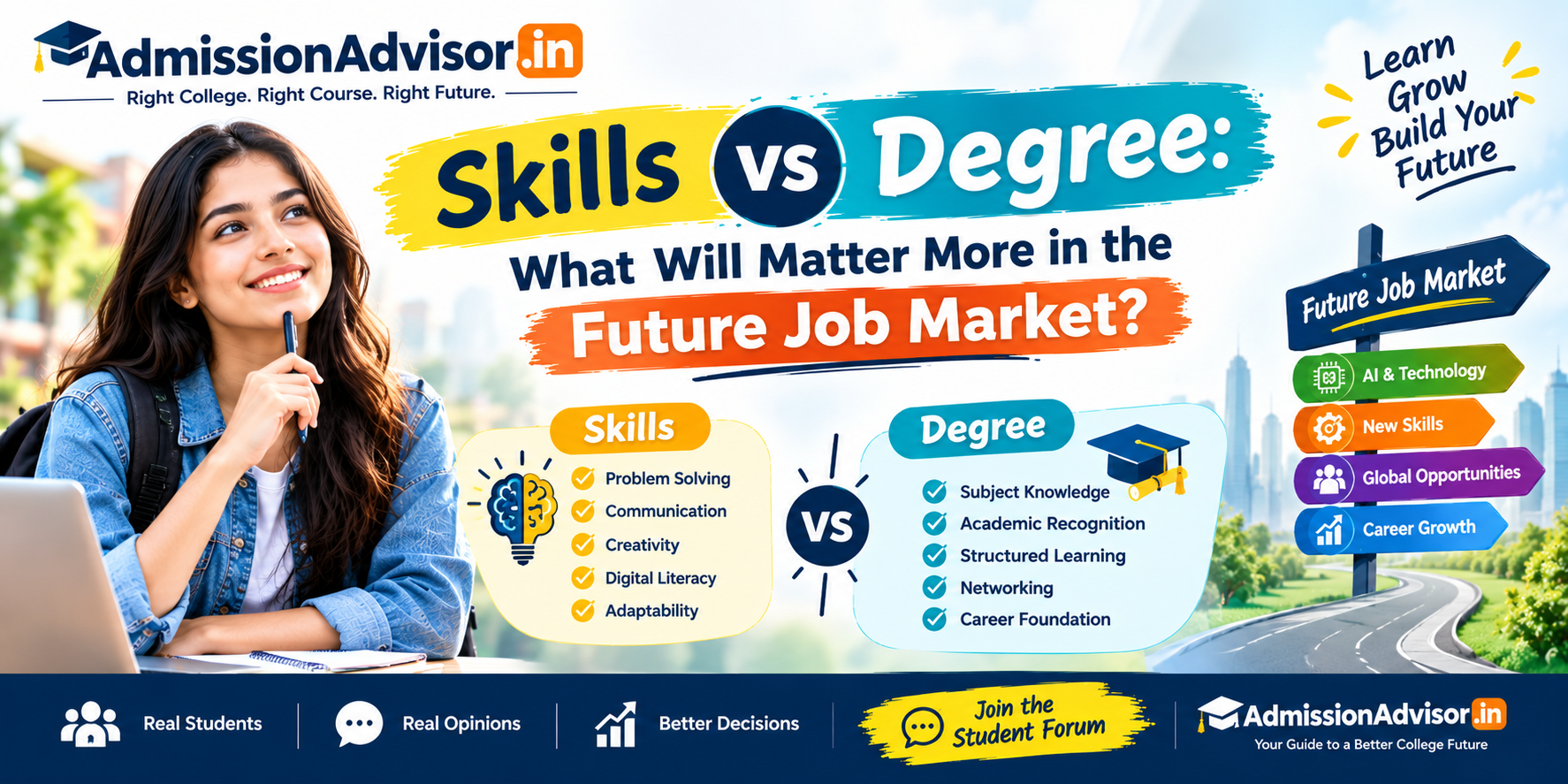
Choosing a career is no longer simply about earning a degree and applying for jobs. As technology, artificial intelligence, automation, and digital workplaces continue to change how businesses operate, students are increasingly asking an important question:
Will a degree be enough, or will skills matter more in the future job market?
The practical answer is that degrees and skills serve different purposes. A degree can provide academic knowledge, structured learning, and eligibility for many professions, while skills help students demonstrate what they can actually do. For many careers, combining both can create a stronger foundation.
A college degree remains important for many professions and industries. Certain careers require specific academic qualifications before someone can enter the field.
A degree can provide:
For example, engineering, medicine, law, teaching, and several other professions often involve formal educational requirements.
A degree tells an employer what you have studied, but skills can demonstrate what you can actually do.
Employers may look for practical abilities such as:
A student with a degree in computer science, for example, can strengthen their profile by developing programming skills and creating real projects that demonstrate their abilities.
Artificial intelligence is changing the way many professionals perform everyday tasks. Students therefore need to understand not only how to use technology but also how to work effectively with it.
Future-focused students can develop skills such as:
Understanding basic AI concepts and knowing how to use AI tools responsibly.
Being able to evaluate information, identify mistakes, and make reasoned decisions.
Technology can provide answers, but people still need to understand problems and decide how solutions should be applied.
Clear writing, presentations, collaboration, and interpersonal communication remain valuable across many careers.
Technology and job requirements can change. Students who continue learning can adapt more easily to new tools and working methods.
The debate is often presented as:
Degree OR Skills?
A more useful way to think about it is:
Degree + Skills + Experience = Stronger Career Preparation
Consider two students:
Student A:
Has a degree but has little practical experience.
Student B:
Has a degree and has also completed internships, built projects, developed relevant technical skills, and improved communication abilities.
Both have academic qualifications, but Student B can demonstrate their knowledge through practical work.
This is why students should think beyond simply completing their syllabus.
One of the best ways to demonstrate skills is through real work.
Students can build experience through:
For example, a digital marketing student could create a sample campaign, analyze website traffic, build a content strategy, and present the results. This provides evidence of practical ability beyond a degree certificate.
Technical knowledge is only one part of career preparation.
Students should also develop:
Communication ? Teamwork ? Leadership ? Creativity ? Problem-solving ? Time management ? Adaptability
These skills can help professionals work with colleagues, customers, managers, and technology.
A technically strong employee who cannot communicate ideas effectively may face different challenges from someone who combines technical knowledge with strong communication and teamwork.
Students don't need to learn everything at once. A practical approach is to build skills alongside their formal education.
Select a course that matches your interests, abilities, and career goals.
Research the skills commonly required for your target career.
Use projects, internships, competitions, and practical assignments to apply what you learn.
Create a collection of projects, achievements, certifications, or work samples.
Practice presentations, writing, interviews, teamwork, and professional communication.
Technology changes continuously, so learning should continue after graduation.
Instead of looking only at the college name or course title, students can evaluate:
The right choice depends on the student's individual goals, interests, budget, and intended career path.
The future job market is likely to continue rewarding people who can learn, adapt, solve problems, and apply knowledge effectively.
A degree can provide the academic foundation. Skills can help students apply that knowledge. Experience can show what they can accomplish in real situations.
Therefore, instead of asking only “Degree or skills?”, students should ask:
“What degree and skills do I need to build the career I want?”
That shift in thinking can help students prepare more deliberately for changing career requirements.
A degree opens an academic and professional pathway; skills help students demonstrate their capabilities.
For students preparing for the future, the strongest approach is not to ignore education in favor of skills—or skills in favor of education. Instead, focus on building academic knowledge + practical skills + real experience + communication + continuous learning.
Your degree can be the foundation. Your skills can help you build on it.
Skills Vs Degree: What Will Matter More In The Future Job Market?
3 October, 2026 By: AdmissionAdvisor Editorial TeamHow To Verify UGC Recognition And University Affiliation Before Admission
22 September, 2026 By: AdmissionAdvisor Editorial TeamCloud Computing Career After B.Tech: Skills, Jobs & Scope In 2026–27
19 September, 2026 By: AdmissionAdvisor Editorial TeamWhich Course Is Better After 12th Commerce? A Complete Career Guide For Students
19 September, 2026 By: AdmissionAdvisor Editorial TeamFirst-Year College Guide 2026: 16 Things Every New Student Should Know Before Starting College
17 September, 2026 By: AdmissionAdvisor Editorial TeamBCA Vs B.Tech CSE: Which Is Better For A Software Career?
15 September, 2026 By: AdmissionAdvisor Editorial TeamNo Internship = No Job? How Important Are Internships Really?
13 September, 2026 By: AdmissionAdvisor Editorial TeamTop 20 Engineering Colleges In India : Ranking, Courses, Admission & How To Choose The Best College
11 September, 2026 By: AdmissionAdvisor Editorial TeamIs College Ranking More Important Than Placement?
9 September, 2026 By: AdmissionAdvisor Editorial TeamCollege Ranking Vs Placement Vs ROI: Which One Should Students Trust?
7 September, 2026 By: AdmissionAdvisor Editorial TeamWhat Should I Check Before Taking MBA Admission
7 September, 2026 By: AdmissionAdvisor Editorial TeamCan BCA Students Get Software Jobs? A Complete Career Guide
6 September, 2026 By: AdmissionAdvisor Editorial TeamHow To Verify Whether A College Is Genuine Before Admission In India
6 September, 2026 By: AdmissionAdvisor Editorial TeamCollege Placement Vs Fees: Is Your College Really Worth It?
6 September, 2026 By: AdmissionAdvisor Editorial TeamB.Tech Vs BCA Vs BBA: Which Course Is Right For You?
4 September, 2026 By: AdmissionAdvisor Editorial Team